
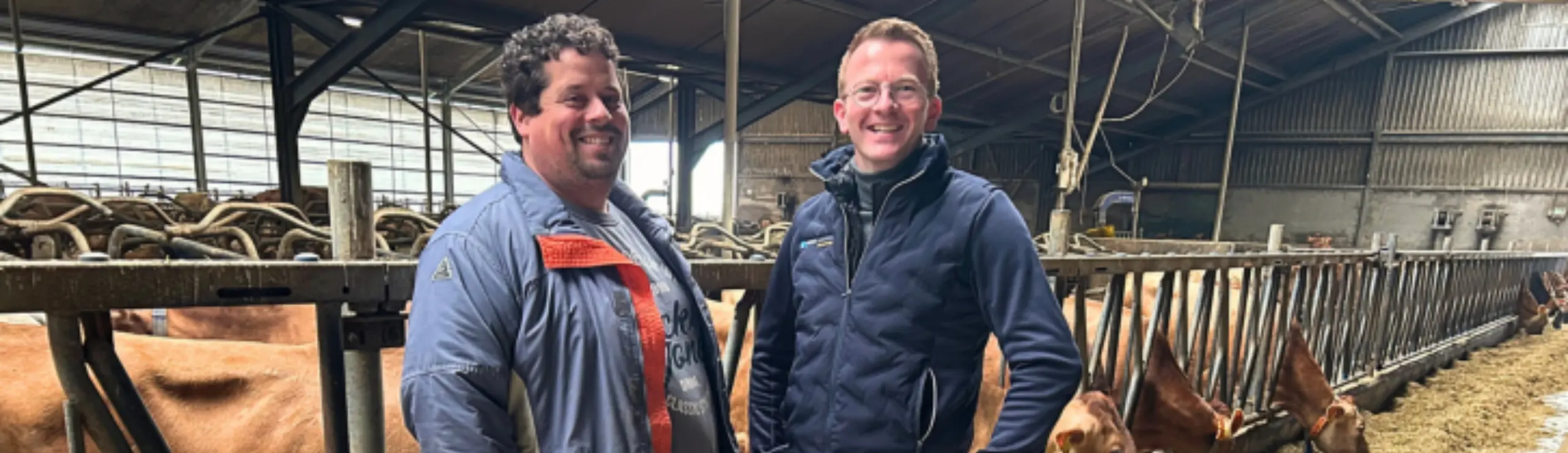
Gerrit and Margreet Meuleman: a deliberate choice for Jersey
With 125 cows and 40 hectares of land, Gerrit and Margreet Meuleman farm in one of the most expensive agricultural regions in the Netherlands. Land prices in their region are around €200,000 per hectare. “It’s top-quality soil here,” says Gerrit. “But that also means you have to work efficiently.” There are many arable farmers in the area, with whom Gerrit closely collaborates in crop rotation systems. On the farm, maize, grass, and fodder beets are grown for their own livestock.
24.03.2026
From Holstein to Jersey
In 2021, Gerrit and Margreet made an important decision: they switched from Holstein and Holstein/Fleckvieh crossbreeds to Jersey. The reason? Hoof problems in the existing herd.
The first Jersey cows came from a Dutch dairy farmer who wanted to switch to A2A2 milk production. The animals that did not have the correct A2A2 genotype became available – and this marked the beginning of Meuleman’s transition to Jersey.
Later, several imports from Denmark followed. In 2024, Gerrit imported 40 pregnant Jersey heifers via VikingLivestock Netherlands. He personally attended the selection in Denmark together with sales manager Harm Jan Brouwer. Since then, VikingLivestock Netherlands has delivered Jersey cows and pregnant heifers to the farm several times. The herd is now almost 100% Jersey.
Feed optimization and performance
“Now that we are mostly milking Jerseys, we have also completely adjusted our feed rations,” says Margreet. “We now optimize specifically for Jersey.”
The ration consists of about 40% roughage, divided into 50% maize and 50% grass. According to Gerrit, there is still relatively little specific knowledge about Jersey feeding in the Netherlands. “There is certainly room for development here for Dutch feed advisors.”
Production currently averages about 7,300 kg of milk per cow with 6% fat and 4% protein. Gerrit is satisfied: “It’s still a young herd. We expect production to increase as the cows get older.”
“We now optimize specifically for Jersey.”
Targeted breeding strategy
The approximately 20 remaining Holsteins and crossbreds are inseminated with Belgian Blue. This ensures that no more Holstein heifers are born and accelerates the transition.
The best Jersey cows are inseminated with sexed VikingJersey semen, in close cooperation with breeding advisor Douwe Schaafsma from K&L. K&L has imported VikingJersey bulls from Scandinavia for decades.
The remaining animals are inseminated with sexed Belgian Blue semen. As a result, mainly bull calves are born from the weaker cows. These Jersey/Belgian Blue crossbred calves are sold at the age of 2–3 weeks.
The Jersey heifers are sent to a local heifer rearer and later return to Gerrit’s farm.
Legislation and efficiency
Within the Dutch phosphate legislation, Gerrit sees clear advantages of Jersey. Because phosphate limits are linked to kilograms of milk production, farmers can keep about 30% more Jersey cows within the same phosphate quota, since Jerseys produce fewer kilograms of milk per cow than Holsteins.
This means more fat and protein production at the farm level. In addition, Jerseys produce less manure, resulting in lower manure disposal costs.
Frequently asked questions
Gerrit is often asked about calf marketing and the lower prices for calves and cull cows. He acknowledges that prices are lower than for Holsteins. “But with a strategy of sexed semen and targeted breeding, it remains manageable.”
In return, there are clear advantages: higher feed efficiency, better hoof health, and a more robust herd.
“But with a strategy of sexed semen and targeted breeding, it remains manageable.”
Cooperation in the chain
Gerrit is positive about the cooperation with VikingLivestock Netherlands. “They look at the entire chain. Harm Jan takes responsibility for the whole process. That gives confidence.”
For the selection in Denmark, he fully trusts VikingLivestock. “I know that quality will be delivered, exactly as we expect.”
The transition from Holstein to Jersey went smoothly. “I’m not someone who plans everything in detail before starting,” Gerrit says with a smile. “But it worked out well. I would do it again without hesitation.”